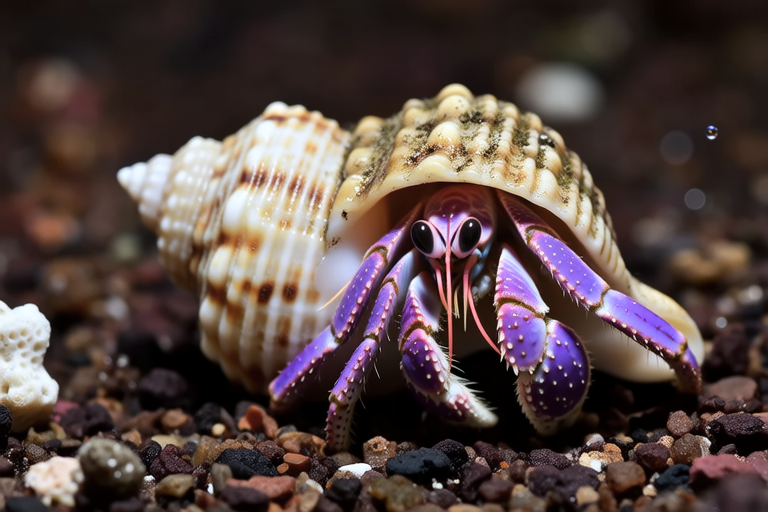
The Intriguing Lives of Hermit Crabs
Hermit crabs are among the most fascinating creatures in the ocean, known for their distinctive behaviors, unique shell-swapping rituals, and complex social structures. These creatures have captivated both casual observers and scientists alike with their endearing appearance that seems almost alien-like. This article delves into the lives of hermit crabs, exploring their habitats, dietary needs, interactions within ecosystems, and common misconceptions. We will also discuss why they make such fascinating subjects for study.
Distinctive Behaviors and Shell-Swapping Rituals
Hermit crabs have evolved a unique way to protect themselves from predators: by living inside discarded mollusk shells. This behavior is not only practical but also highly strategic. As hermit crabs grow, they outgrow their current shells and must find larger ones to accommodate their expanding bodies. This process involves a series of shell-swapping rituals that can be both competitive and cooperative. Hermit crabs often gather in groups to search for new shells, and when one finds a suitable replacement, it initiates a chain reaction where each crab trades up for a better fit. This communal approach ensures that all members of the group benefit, promoting a sense of cooperation within the species.
Complex Social Structures
Despite their solitary nature, hermit crabs exhibit complex social behaviors. They live in close proximity to one another, forming large colonies that can number in the thousands. Within these colonies, there is a hierarchy based on size and strength. Larger hermit crabs dominate smaller ones during shell-swapping events, while weaker individuals may form alliances to improve their chances of securing a better shell. Additionally, hermit crabs communicate through chemical signals and vibrations, which play crucial roles in coordinating group activities and avoiding conflicts.
Adaptability and Survival Strategies
Hermit crabs are highly adaptable creatures that have developed several survival strategies over millions of years. Their ability to inhabit various types of shells allows them to thrive in diverse environments ranging from shallow coastal waters to deep-sea trenches. Furthermore, hermit crabs possess specialized appendages called pincers or chelipeds, which they use for defense against predators and for manipulating objects in their surroundings. These adaptations enable hermit crabs to exploit different food sources and navigate challenging terrains with ease.
Habitats, Dietary Needs, and Ecosystem Interactions
Hermit crabs inhabit a wide range of marine environments, including coral reefs, rocky shores, sandy beaches, and mangrove forests. They prefer areas rich in organic matter and debris, as these provide ample hiding spots and potential food sources. The diet of hermit crabs consists mainly of algae, detritus, small invertebrates, and plant material. By feeding on decaying organic matter, hermit crabs help recycle nutrients back into the ecosystem, playing an essential role in maintaining ecological balance.
Endearing Appearance vs. Alien-Like Characteristics
At first glance, hermit crabs appear charming and endearing due to their small size and soft abdomen wrapped around the shell. However, closer examination reveals some truly alien-like features. For instance, hermit crabs lack a hard exoskeleton covering their entire body; instead, they rely on borrowed shells for protection. This adaptation gives them an otherworldly appearance that has inspired countless works of art and literature throughout history. Moreover, hermit crabs’ long antennae and compound eyes add to their eerie charm, making them stand out among other crustaceans.
Common Misconceptions About Hermit Crabs
One prevalent myth about hermit crabs is that they are entirely dependent on human intervention for survival. In reality, wild hermit crabs lead independent lives and do not require constant care from humans. Another misconception is that hermit crabs are solitary creatures without any social bonds. While hermit crabs spend much time alone, they still interact with others through shared resources and communication methods. Finally, some people believe that hermit crabs cannot survive outside of water. Although terrestrial hermit crabs need access to moisture to breathe through gills located beneath their abdomens, many species can thrive in semi-aquatic environments.
Why Hermit Crabs Are Fascinating Subjects for Study
Hermit crabs offer valuable insights into evolutionary biology, ecology, and animal behavior. Researchers continue to investigate how these creatures adapt to changing environmental conditions and develop innovative solutions to overcome challenges. Additionally, studying hermit crabs provides opportunities to explore questions related to symbiosis, resource competition, and cooperative behavior. Ultimately, hermit crabs serve as excellent models for understanding broader biological principles applicable across different taxa.
Conclusion
Hermit crabs are truly remarkable organisms whose lives are full of surprises and wonders. From their distinctive shell-swapping rituals to their complex social structures, these creatures demonstrate incredible adaptability and resilience. Whether viewed as adorable pets or mysterious denizens of the deep, hermit crabs remain captivating subjects worthy of further exploration. By continuing to learn about hermit crabs, we gain deeper appreciation for the diversity of life on Earth and the intricate web connecting all living things.
